
There is nothing to be worried about as bilateral ties are robust with solid foundations. Both are on the same page on the economic and defence/security ties bilaterally and globally and that shall continue irrespective of change in political dispensation in either country, points out Dr Rajaram Panda.
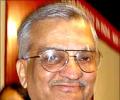
Dismissing a top nuclear scientist's contention that Pokharan II was not a complete success, Atomic Energy Commission chief Anil Kakodkar on Friday said the tests in 1998 achieved '100 per cent desired results'.Speaking at a function organised by the Raja Ramanna Centre for Advanced Technology in Indore, Kakodkar said, "Pokhran II tests were a complete success and they achieved 100 per cent desired results."

The Defence Research and Development Organisation has initiated talks with the Indian Air Force to design and develop a fifth generation fighter plane, to be called Medium Combat Aircraft (MCA).
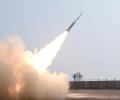
Defence sources said the missile, which was launched from a mobile launcher at 3.15 pm, successfully hit a target attached to a pilotless target aircraft.

The drug comes in powder form in a sachet, which is taken orally by dissolving it in water. It accumulates in the virus-infected cells and prevents virus growth by stopping viral synthesis and energy production.
A terror suspect, who allegedly conspired to kill prominent politicians and journalists in three states, has been ordered to be released on 'statutory' bail by the National Investigation Agency court since the NIA had failed to file chargesheet against him, a lawyer representing him said on Friday.
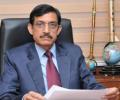
Defence Minister Manohar Parrikar on Wednesday said there was no controversy in the sacking of Avinash Chander as Defence Research and Development Organisation chief and it was he who recommended that the position should be held by someone from a "slightly younger generation" and not by someone on contract.
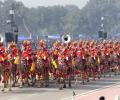
President Droupadi Murmu will lead the nation in celebrating the Republic Day, and Egypt's President Abdel Fattah al-Sisi will be the chief guest at the ceremonial event.

Defence Minister A K Antony has recommended a CBI probe into an alleged recruitment scam in DRDO where several senior officers including two of its former chiefs are under the scanner.
Nuclear-tipped missiles don't give security, says Praful Bidwai

Addressing a Defence Research and Development Organisation event in Leh, Singh asked how can India talk to Pakistan when it keeps trying to destabilise India using terror.

The massive exercise code-named Iron First 2016 would involve the participation of 181 aircraft departing from multiple bases, and demonstrate a synchronized aerial ballet that would showcase its deadly combat capability over the entire spectrum of aerial operations.
India succefully test-fired a 3,000-km Agni-III missile on April 12 this year.

India on Monday successfully flight-tested its indigenously developed SMART torpedo system, which DRDO said will be a "game changer" in anti-submarine warfare, marking yet another milestone in strengthening the country's maritime strategic capabilities, defence sources said.
It will be ready for field trials by the end of December, the government told the Lok Sabha.
Lakshya is the indigenously developed Pilotless Target Aircraft.
New Delhi's moral and ethical protestations that India's space programme is entirely peaceful are facing embarrassing questioning after the Defence Research and Development Organisation (DRDO) apparently oblivious of the policy implications of its statements publicly announced a roadmap for its ambitious military space programme.

It said clinical trials of the drug 2-deoxy-D-glucose (2-DG) showed that it helps in faster recovery of hospitalised patients and reduces supplemental oxygen dependence.

By the end of next year, Indian fighter planes could be equipped with indigenously-developed 'glide bombs', which will be guided to their targets for precision attacks.The first-of-its-kind bomb in the country, being developed by the Defence Research and Development Organisation, will boost India's strike capabilities as targets can be hit even beyond the range of a fighter aircraft.
'We cannot forget what happened in the past, and there is no room for complacency,' says Defence Minister Pranab Mukherjee.
Defence Research and Development Organisation's claim about being in a position to export Light Combat Aircraft Tejas has been dismissed as premature and unrealistic by former top Indian Air Force officers who want it to focus on getting the indigenous fighter plane inducted into own air force first.

Changing sand patterns around India's lone missile test-firing range at WheelerIsland off Odisha coast is causing serious concern for Defence Research and Development Organisation and the agency is seeking assistance from Chennai-based National Institute of Ocean Technology to control the erosion.

"The fire which broke out in the underground magazine store of the Proof and Experimental Establishment (PXE) in the early hours has been fully controlled by fire-fighters," said Director of PXE, R Appavuraj.
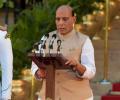
Containing infiltration of terrorists into Jammu and Kashmir from Pakistan will be another key focus area.
The Integrated Test Range of Defence Research and Development Organisation (DRDO) has taken various measures to protect its facilities at Chandipur and Abdul Kalam Island in Odisha, which are likely to be affected by cyclone 'Yaas', an official said.

The mission life of the 2,250kg GSAT-7A, built by ISRO, is eight years. It will provide communication capability to users in Ku-band over the Indian region.
The Bengaluru Police was left red-faced after Ajaz Ahmed Mirza, a junior scientist at Defence Research and Development Organisation's Centre for Airborne Systems who was arrested in connection with a major assassination plot, was let off by a special court on Thursday
The missile was aimed at a moving object, sources said.
India will test fire its long-range surface-to-surface missile, Agni-III, by the year end and has started induction of the Agni-I and Agni-II versions in a newly raised strategic command, Dr M Natrajan, scientist claimed on Tuesday.

The vertical approach was one of the at least five options on which preparatory work had begun some days back, as anxiety mounted over the fate of the men trapped in the under-construction tunnel on Uttarakhand's Char Dham route.

After a comprehensive analysis is undertaken to find the reasons of this incident, "we will build an elaborate plan to avert any potential tragedy going forward", Rawat said.
The underwater leg of the nuclear triad has always been regarded as the most survivable. Going by the January 27 test, the K-15 missile is well up to the task. Ajai Shukla reports
The scientific adviser to defence minister said the Defence Research and Development Organisation will be building the vehicle in about 30 months.
Indigenously developed Light Combat Aircraft 'Tejas' will be inducted into the Indian Air Force this year, Defence Research and Development Organisation chief V K Saraswat has said.
The much-maligned DRDO has developed and implemented several new initiatives designed to make life easier for the Indian soldier stationed in high altitude areas, reports RS Chauhan
Astra is an indigenously developed air-to-air missile.

India on Friday night successfully conducted maiden night test of its indigenously developed nuclear-capable Agni-I ballistic missile with strike range of 700 km from a test range off Odisha coast as part of a user trial by the Army.
The missile, weighing 650kg, can carry a 50kg payload over a distance of 25km.
 © 2026 Rediff.com - Advertise with us - Disclaimer - Privacy Policy - Sitemap - Feedback - About us - Terms of use - Grievances